
Ars Sacra — works
for the sacred space.
Cross, figure, relief: sacred works are made to commission and stay in the place they were made for. What you see here is the path that leads there.
From the sketch
to the polychrome finish.
Sacred works do not go into storage. They go into a church, a chapel, a cemetery or a house. So each one begins with the place: how high it will hang, from what distance it will be seen, what light falls on it. Only then come the sketch and the clay model.
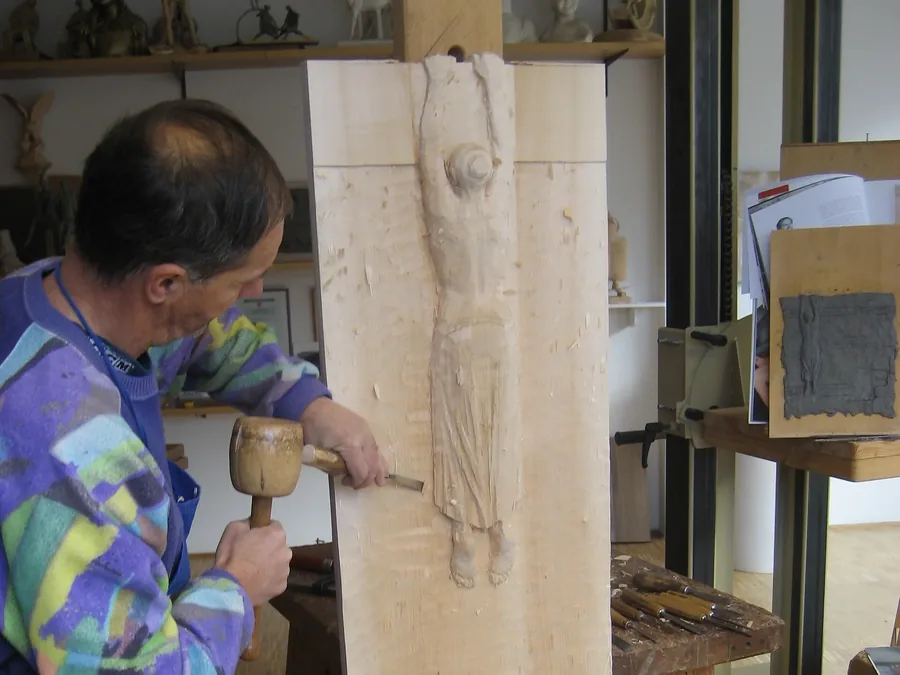
The work is carved in Swiss stone pine, lime or walnut, on request polychromed and heightened with gold leaf. Bronzes are cast at the Fonderia, and I have a say in the patina.
Three steps
The same path the sacred works take.
Related works
Figures that speak the same language: polychromed wood, gold leaf, the small figure against a quiet ground. Independent works — not commissions for sacred spaces.
What does Ars Sacra mean?
Ars Sacra is the field of sacred work: cross and crucifix, figures for altar and chapel, reliefs for church interiors and works for cemeteries. They are made to commission in the studio in Selva di Val Gardena and stay in the place they were made for.
How does a sacred commission work?
First the conversation on site: hanging height, viewing distance and the fall of light determine the size and the pose of the figure. Then come the sketch and the clay model, then the roughing out in Swiss stone pine, lime or walnut, and finally the polychrome finish, with gold leaf on request. Bronzes go to the foundry for casting along the way.
How long does a sacred commission take?
That depends on size and execution. For a larger figure, several months pass between the clay model and the finished polychrome finish, because every step stays in one pair of hands. I give a reliable timeframe after the first conversation.
A work for your church or chapel?
From the first conversation on site to the finished polychrome finish, everything stays in one pair of hands. Call, or write and tell me what you have in mind.
Send enquiry